
Automatic doors are everywhere these days: offices, homes, shops, hospitals, hotels, factories, and more! And it’s not surprising. They’re convenient, accessible, and secure – benefits that work for everyone. At CDVI, we’re an unusual case as we manufacture both the access control solutions and the automatic door operators. And that means our products support and complement one another perfectly.
In this blog, we’ll look at some of the key technology in automatic doors, such as sensors, motors, and control systems. Plus, we’ll explore how integrating access control and door automation creates seamless entry experiences for all users.
Why automatic doors matter
Automatic doors are one of those things that barely cross most people’s minds. And that’s a good thing! A good automatic door installation is seamless and discreet – you’ll only notice it if you walk into it, it crashes into you, or you end up stuck in the rain outside a door you want to enter. They deliver a range of benefits that are often under-appreciated:
- Convenience. If you’re carrying a box, pushing a pram, or using a wheelchair, an automatic door makes getting around so much easier.
- Accessibility. We believe everyone deserves simple and secure access to their homes, workplaces, and leisure facilities. Automatic doors mean everybody is included on an equal footing.
- Compliance. Automatic doors contribute to meeting regulatory requirements like DDA and the Equality Act. And compliance means avoiding discrimination claims and potentially hefty consequences.
- Hygiene. For a brief period in 2020, we all suddenly took notice of how many shared surface we touch every single day. And we seem to have forgotten it just as quickly! Less physical contact with shared surfaces means less opportunity for bacteria and viruses to spread from person to person.
- Security. When combined with access control systems, automatic doors only open for authorised people. And that means confidence that nobody else is wandering around your building unchecked.

Sensors: detecting presence and ensuring safety
How door sensors work
Have you got a light outside your front door that comes on automatically when you approach the house in the dark? That is a PIR – a Passive InfraRed sensor. But do you know what that actually means?
Active vs passive sensors
Active sensors transmit invisible light rays from the sensor into an activation zone. They then measure the rays that rebounds off the environment in that zone and returns to the sensor. When a person enters the zone, the sensor detects a change in the invisible rays rebounding back to it. And that’s what triggers the action of the circuit.
Meanwhile, passive sensors don’t send out any invisible light rays of their own. What they do instead is exploit the natural radiation that you and I and all the living beings on the planet emit. When the sensor is installed, it picks up the ambient radiation in the environment. Any increase in that radiation caused by a person walking into the detection zone is what triggers the action.
Common sensor technologies
Sensors come in different types which utilise different methods of detecting people. The three most common are infrared, microwave, and laser sensors. Infrared and microwave are both types of light rays which are invisible to the naked eye. They have the longest wavelengths of the electro-magnetic spectrum.

Laser sensors, meanwhile, utilise more sophisticated technology. They’re more accurate by a degree of magnitude, and easily overcome some of the downsides to infrared or microwave sensors. Many laser sensors use “time of flight” technology, measuring tiny changes in the time it takes for a laser to fire out, bounce off something, and return to the sensor. Lasers are so accurate that distances can be calculated down to the millimetre. Some laser sensors produce ‘curtains’ of lasers that enable the sensor to establish a 3D representation of the person or object in its path.
Types of sensors
There are three main ways sensors are used in access control:
- Motion detection. These sensors detect when a person is approaching the door and immediately trigger the door to open and let them pass through.
- Presence sensors. These sensors detect a person or object blocking the path of an automatic door, ensuring that the door doesn’t close and hit somebody standing in the threshold.
- Safety sensors. These sensors prevent collisions and injuries in areas such as the door’s opening path or along the hinge line. They also help with complying with regulatory standards.
Motors: the power behind movement
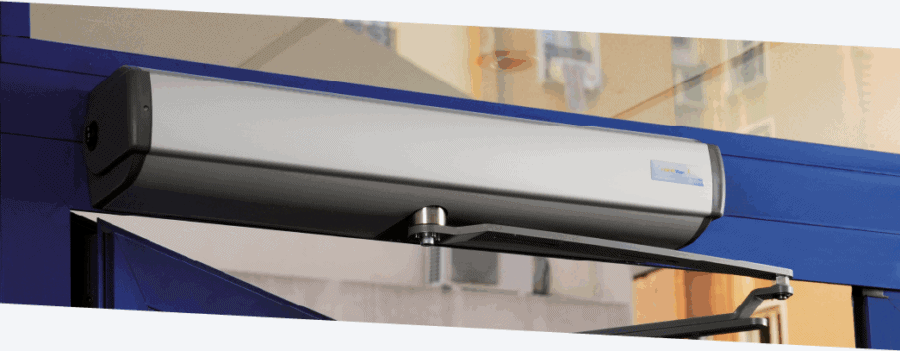
The motor in an automatic door operator is the component that provides the physical force needed to open or close the door. The DIGIWAY door operator by CDVI comes in two models: the DIGIWAY Plus, with a motor driving both the opening and the closing, and the DIGIWAY SR, which has a chain-driven spring return mechanism instead.
Types of motors used in automatic doors
There are a number of different motors used by manufacturers of automatic door operators. The terminology can be confusing, so we’ll simplify it here.
AC motors
This type of motor is best suited to very heavy or industrial doors. They’re great in places which don’t need as much precision in the door movement. However, they’re often noisy and have limited control range, as well as often requiring a higher energy draw. As they can be bulky, they’re not generally used in settings where a neat and tidy finish is preferred.
BLDC motors
This acronym stands for brushless DC motors. The brushless setup means there is no internal brush to degrade over time and require replacement. These motors come at a high initial price tag and require advanced controllers & diagnostics – but their smoother controlled torque curve and brushless setup means they’re well suited to demanding environments with high levels of foot traffic.
PMDC motors
This is the type of motor inside our DIGIWAY door operators. The acronym stands for permanent magnet DC motor. These motors deliver the better refinement of BLDC without over-engineering and keeping costs under control. They’re also quieter, smoother, and more straightforward to install than AC motors, meaning they don’t have the industrial feel of AC and suit public settings.
PMDC motors remain a smart and balanced choice for the majority of automatic door applications. If your entrance doesn’t have the level of traffic you’d expect in an airport or shopping centre, and isn’t an industrial setting, it’s likely a PMDC motor will suit. Their reliability, accessibility and simplicity of installation and servicing means you’ll get a dependable solution with a reasonable cost of ownership.
Control systems: the brain of the operation
What door controllers do
With door controllers, the clue is in the name. These components control what the door is doing. They do this through a number of key functions:
- Interpreting signals from sensors.
- Interpreting signals from access control devices and systems.
- Activating motors to open or close the door.
- Monitoring and managing the timing of door opening and closing.
- Enforcing safety rules, such as immediately stopping the door when obstacles are detected.
Features of DIGIWAY control systems
The DIGIWAY door operator control system enables a very high degree of customisation. We know that every door is unique, and tiny differences between one site and the next will affect the configuration of the door operator. Nobody wants doors slamming, being blown open by strong gusts of wind, or catching on squeaky hinges every time they open. Here are just some of the custom configurations available in DIGIWAY door operators.
Adjustable opening and closing speeds
Fine-tuning the speed at which the DIGIWAY opens and closes enables the installer to tailor the solution to the site. Depending on the foot traffic at the site, safety regulation compliance, and the overall weight of the door, these speed settings are minutely customisable.
Electrolock & opening jolt
Installers can customise the electrolock hold time and electrolock torque. These help account for situations where the door needs more closing force to engage a lock, or an extra jolt to release a lock in a windy corridor or high-pressure environment.
Safety & detection mode
Customising settings for sensor and safety inputs mean installers can tailor the solution to the environment, configuring different reactions in different operating conditions. As well as improving traffic flow and enhancing safety, this supports compliance with regulations like EN16005.

Bringing it all together: the complete automatic door ecosystem
Imagine you’re approaching an automatic swing door at the end of a corridor in an office building. The first thing that happens is a sensor detects your body approaching the door. There’s no access control on this door, so just walking towards it is enough to trigger an opening. Once the sensor detects you, it sends a signal to the door controller. The controller in turn signals the motor to wake up and do its job, pushing the door open just in time for your arrival. The door controller is set to hold the door open for a short period to ensure you’re safely through, and then it triggers the closing mechanism ready to start again.
Automatic doors are about convenience, frictionless flow, and accessibility. They’re quiet and unassuming, and most people wouldn’t believe how complicated they can be! But we know that a lot of different components and some clever engineering go into ensuring every automatic door is smooth, secure, and effective.
Understanding the technology behind automatic doors is crucial, whether you’re choosing a system for your building or installing one for a customer. The knowledge of what’s involved and why means you’re ready to evaluate the site and make an informed and balanced choice. For most sites with moderate levels of foot traffic, DIGIWAY is a simple, cost-effective choice that delivers reliable door automation without over-engineering.